Color Coding
Every colour carries a code that says where it sits in colour space. Read it and you already know roughly what the colour looks like — which is the point, and it is why the codes are not serial numbers.
The code, in one line
Three facts, in the order that a designer actually cares about them: how saturated, what hue, how light. Everything else — the name, the spectrum, the subsets — hangs off that.
| Part | Reads | Comes from |
|---|---|---|
| 8 | Chroma — how far from grey | the tens of C |
| R4 | Hue — one of 36 bins, each 10° wide | the hue angle |
| .52 | Lightness | L, rounded |
The hue circle: six letters, six steps each
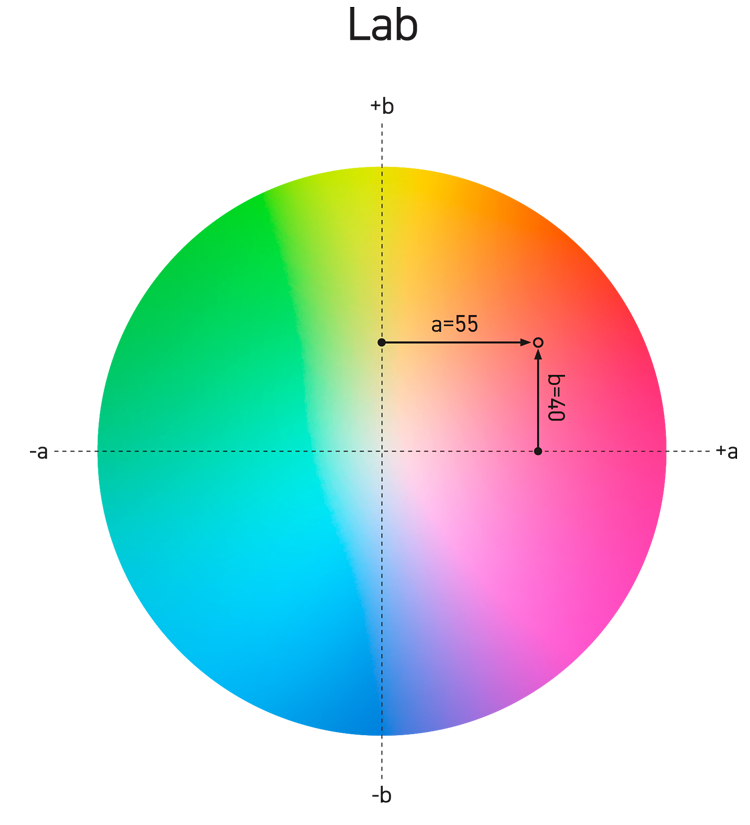
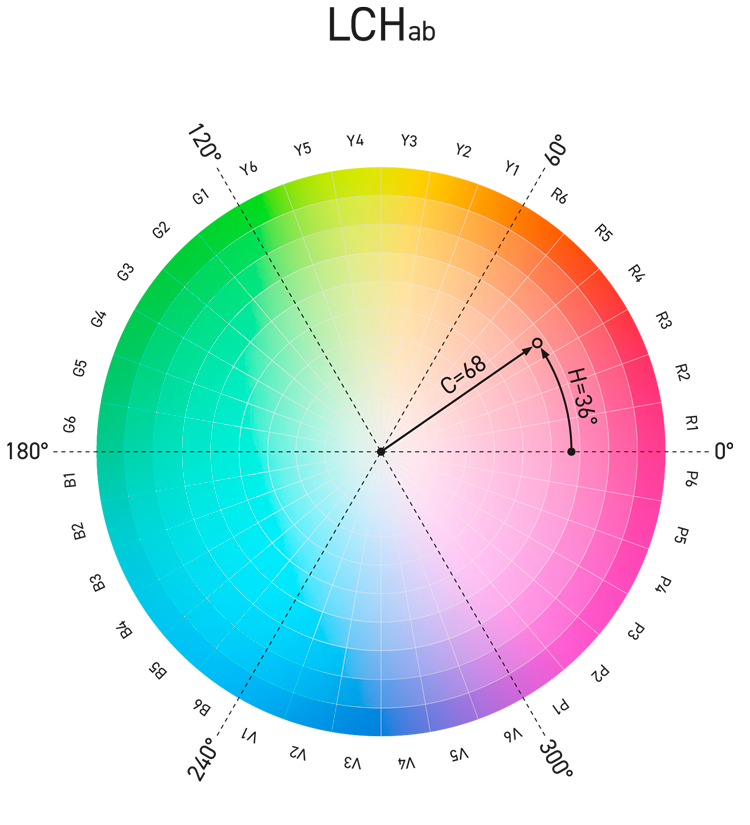
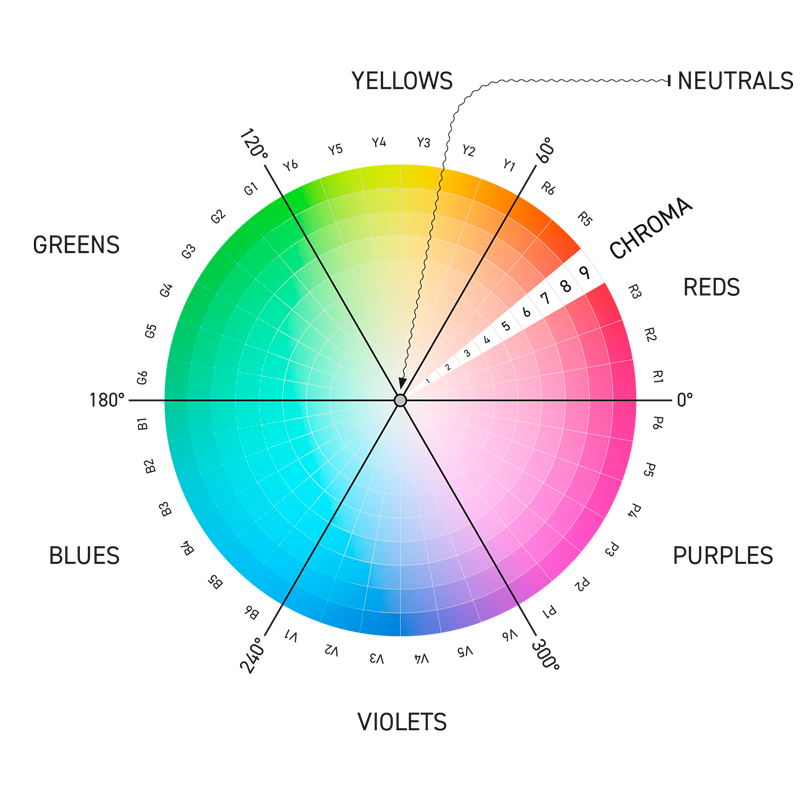
The circle is divided into 36 bins of exactly ten degrees,
grouped into six named families. R1 starts at 0°;
P6 ends at 360°.
| Letter | Family | Bins | Hue angle |
|---|---|---|---|
| R | reds through oranges | R1 – R6 | 0° – 60° |
| Y | yellows through yellow-greens | Y1 – Y6 | 60° – 120° |
| G | greens | G1 – G6 | 120° – 180° |
| B | cyans through blues | B1 – B6 | 180° – 240° |
| V | blue-violets | V1 – V6 | 240° – 300° |
| P | purples through magentas | P1 – P6 | 300° – 360° |
Ten degrees is a deliberate size. Wide enough that a family means something to the eye; narrow enough that two colours in the same bin are recognisably related. Every bin in this library holds between 90 and 153 colours, which is what an even division of a real gamut looks like — there are more printable reds than printable violets.
Chroma: how far from grey
The leading digit is the tens of the chroma value. 0 is nearly
grey; 9 is as saturated as the library goes.
| Digit | Chroma | Reads as |
|---|---|---|
| N | under 0.5 | a true grey — no hue letter at all |
| 0 | under 7.5 | a grey with a visible cast |
| 1 – 3 | to 40 | muted, tinted, earthy |
| 4 – 6 | to 70 | clearly coloured |
| 7 – 9 | 70 and above | saturated; 9 reaches 112 |
The boundaries are approximate by design. A colour sitting on one takes whichever digit leaves the code unambiguous, because no two colours may carry the same code — that rule outranks tidiness.
Lightness
After the dot: L, rounded to the nearest whole number.
Nothing more. 8R4.52 has an L of 52; N.93 has an L of
93.
The theoretical range is 0 to 100. The library runs from about 5 to 93, because it is made of printed samples: no ink is as dark as theoretical black, and no paper is as bright as a perfect reflector.
Neutrals are their own family
A grey with essentially no hue has no hue to name, so it gets a short code:
N and its lightness. N.36 is a grey at L 36.
There are 36 of them, 1.90 to 2.00 ΔE00 apart from L 5 to L 93 — a ramp built to read as even rather than to be numerically even.
Reading a code without looking it up
This is the part that repays learning, and it takes about a minute.
| Code | What you know before you look |
|---|---|
| 9Y3.73 | Very saturated, yellow at 80–90°, light. A vivid yellow. |
| 1B4.30 | Barely coloured, blue, dark. A blue-grey shadow tone. |
| 6R5.34 | Strongly coloured, red-orange, mid-dark. A signal red. |
| N.87 | A light grey. Nothing else to say, which is the point. |
Two codes that differ in one place are neighbours in that dimension. Change the last number and you move along the lightness ramp; change the letter-digit pair and you rotate around the circle. A palette can be built by reading rather than by browsing.
Names sit on top, and never replace the code
Every colour carries a plain English name: 8R4.52 Pyrrole
Scarlet. The name is a convenience for people; the code is the
identity.
Never write a name without its code in front of it. The code is what still resolves if the name ever changes.
Not a style preference. Names can be withdrawn — if someone holds a word
as a trademark, the honest response is to stop using it — and a document
carrying 8R4.52 Pyrrole Scarlet survives that while one carrying
only the name does not. A withdrawn name is never given to another colour, in
any language.
Names in other languages
Colour vocabulary belongs to a language and a culture, and a literal translation is usually the wrong answer. The library is built so a colour can carry a different name in each language, all resolving to the same code, none of them a translation of another.
Why the codes were designed from nothing
They could have followed an existing system. They deliberately do not.
A code derived from a colour’s own coordinates belongs to nobody else, claims nothing about anyone else’s numbering, and cannot be taken away. It is also reproducible: given the measurement the code follows. Nobody allocates it and there is no register to consult.
Read next
- Library BrowserFinding a colour when you do not know its code
- Subset StatisticsHow the space is divided, and how well
- SpecificationEvery figure of the library in one table